









Cloud hosting and Disaster Recovery
-
Contributor Tareq Qasem
Education, Technology, Innovation Published DATE 19/01/2021 22:10
-
1382 Views
Disaster recovery Data center implementations vary, each and every organization can have their approach to implement it, some organizations can adopt cloud hosting as DR if they are already on cloud, it shouldn't be isolated but it can be available active-active with the main data center.
Most of the organizations aim to build their Disaster Recovery (DR) site to stand for crisis, secure their business and ensure it continues operating and serving customers during any crisis or disaster or even an incidental situation which is recognized as disaster.
One of the key reasons organizations consider to adopt AWS cloud hosting and placement is their need of more available site to operate during crisis, so they decide to build Disaster Recovery by adopting one or more different approaches for DR implementation, one of the key differences between having a DR as on premises alternative Data Center (DC) and cloud hosting DC is the features of the availability of the services/servers and the distribution of the services across DC(s).
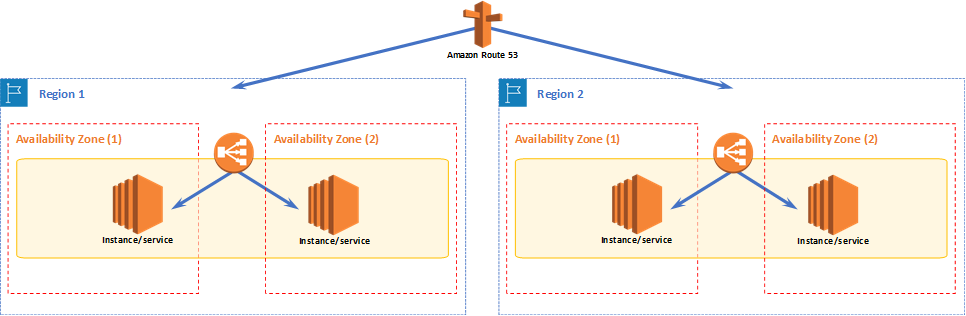
AWS Cloud hosting offers Multi Zones (Availability Zones) and Multi Regions availability for hosting services and instances in order to extend the availability of the services and the availability of the business in any organization, this feature can be implemented or even configured seamlessly in cloud implementation and barely can be achieved in traditional DCs and DRs along with high cost impact to be achieved in these traditional implementations.
Organization can adopt a primary hosting region and a secondary region for the DR, the instances and services can be configured to be cross regions, even can be implemented and configured to be always active on both primary and secondary regions, thus you even eliminate the DR concept and your services and business will never stop.
Moreover, the services and instances can be made available across AZs in same region, so either one leg/node of each instance tier can be deployed on in one AZ and the other leg/node on the other AZ or you can scale out more instances/services to be highly available in each AZ as well.
These flexibilities, elasticity and availability features are making cloud hosting distinctive and a vital to be put as a robust option for hosting adoption.

Contributor
Tareq Qasem
Senior Manager Enterprise Architecture & Integration
Expert in Enterprise Architecture, Systems Integration, Cloud Architecture and eTransformation
Trending Now
-
01
 23/03/2025 16:49
Future Internet Announced as Main Sponsor for World Crisis and Emergency Management Summit 2025 (WCEMS)
-
02
 30/09/2022 17:18
Dubai Metaverse Assembly Showcases the Potential of Metaverse across Vital Economic Sectors
-
03
 28/09/2022 08:47
Dubai Metaverse Assembly’s Side Sessions Unpick Metaverse’s Most Pressing Questions
-
04
 16/09/2022 10:23
Global Excellence Award Announces Winners of 2022 Marketing and Communication Award
-
05
 18/04/2022 09:31
GX TALKS: “Customers First : UAE’s Secret Recipe”